
Hard red wheat is the workhorse of the flour world. This is the main type of wheat in general commercial all-purpose flour. 95% of the wheat grown in Kansas is hard red (winter) wheat. In contrast, the wheat region of Washington (my homeland) grows more soft white wheat.
For this batch of pasta, I was using spring hard red (grown in the northern plains with a shorter growing season), which has a higher protein content than its winter sibling. It may have been a little bit of a hearty overkill, but my idea was to make a rustic high extraction (near whole wheat-type) pasta.
I had actually milled and bolted the flour a week earlier, leaving it as straight flour (bran and germ removed) in the fridge until I had time to put it to use. The extraction rate for this straight flour was disappointing though, coming out a little low at 60% of the whole berry using the #40 mesh sieve. 70-75% would be the ideal range, although I don’t generally get that high. I think that is more the result from high efficiency roller mills. I will have to see what happens with the next batches, but I am worried that my mill needs some maintenance.

Originally, this pasta was going to be made with 100% straight flour, but once I started working with it I felt it was too rough. Instead the final flour make-up was 200g of the straight flour and 100g of fine flour. The fine flour was just the same straight flour passed through my #80 mesh sieve. I find the #80 mesh to be the lowest grade that produces a soft flour approaching general all-purpose texture and properties.
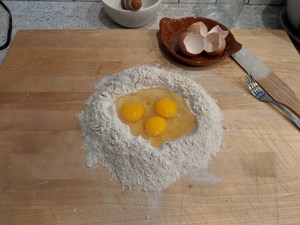
For the dough, I added a sprinkling of sea salt to the flour and added three whole eggs to the center flour well. I should have used four eggs (or probably just an extra yolk), as this flour was a little dry and fresh milled flour usually needs more liquid. Instead though, I ended up with a good amount of flour that didn’t get incorporated into the dough. I wasn’t worried though as I didn’t need that many ravioli for just a small family dinner.

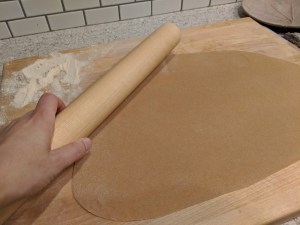
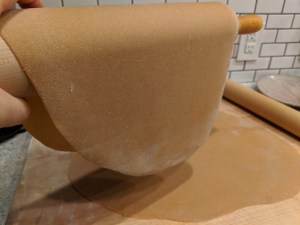
The dough was a little on the tough side (strong spring wheat gluten), but still rolled out smooth and even with an overall nice feel. A stuffed pasta dough does need to be tougher than a dough for noodles. After resting the dough, I hand rolled and cut it into 3 inches strips.
The ravioli filling was roasted root vegetables (potatoes, carrots, celery root, and turnip), well smashed up and mixed into ricotta, Parmesan Reggiano, parsley, olive oil, lemon juice, and fresh sage.

They didn’t come out beautiful, but they are the best ravioli that I have made before, as far as being a consistent size and well formed.
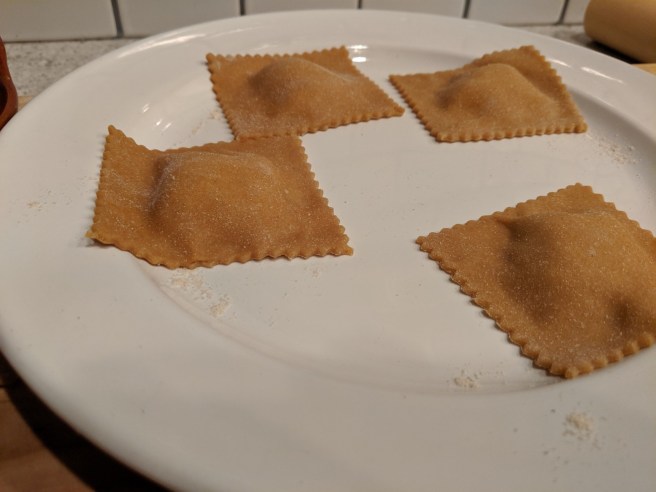
The final dish was pretty tasty, in my opinion. The pasta was a bit “wheaty.” My daughter didn’t seem to be a huge fan, but she ate maybe one ravioli after I pulled one from the bottom of the dish that didn’t have any chopped parsley on it (a small victory). I was worried that the rustic pasta would be too hearty for the subtle flavors of the root vegetables, but it carried the flavors well.
The finished dish was made by rendering down a little pancetta, frying some sage leaves in the fat, then giving the ravioli a toss in some of fat and butter, and lastly adding in the remainder of the roasted root vegetables and tossing the pancetta and sage leaves back in the pan. Drizzled with a finishing olive oil, grated Parmesan Reggiano and chopped parsley to top it off.

 whole-purpose.com
Now that’s a mountain of comfort food!
LikeLike
Joe, this blog is super helpful, thank you! I’m considering a starter set of sieves, which are expensive when you choose made in USA. I’m thinking I’ll get only three sieves: #40, #80 and #120. If you could only have three sieves, which mesh sizes would they be?
LikeLike
I think I would go with 50, 80, and 100. 80 has been my goto for standard flour. I find that the 120 is just too much work to get a full batch of flour, but the results are great when I do. Using a 100 I think would still get nearly that same extra fine flour, but more realistic for home milling. 40 leaves a bit too much roughage for the typical taste I am got for. Glad you like the blog.
LikeLike
Thank you so much!
LikeLike