
While it remains my opinion that you can’t make great pizza at home (without an elaborate setup), you can make good pizza if you stick with what works for your kitchen. For me, that is cast iron skillet and sheet pan pizza. All the more reason to highlight good dough and that starts with good flour.
I considered making a 00 type flour using my #120 mesh sieve, but decided it was just a bit of an overkill for having pizza with friends and kids. By chance, the next week a different group of friends happened to have a discussion on whether 00 flour was better for making pizza. The consensus was that they didn’t really like it, as it wasn’t very tasty and felt it made too flat a crust. I found that a little surprising, but looking into it later learned that King Arthur makes a 00 “Italian” flour that is low protein, which may have been what they used. For commercial OO flour, Caputo is the gold standard with 12.5% protein content, contrasted with 8.5% for the King Arthur (way too low).
Milling a Hard Red and Einkorn Blend
For this pizza party, I decided on making a blended flour from hard red spring wheat and einkorn. Einkorn is an ancient grain, possibly the oldest, that produces a sweet nutty flour with a soft yellow color. Alone it doesn’t have the best dough (rheological) properties, as it has a weak gluten, but it adds good flavor. This type of pressed-to-form pizza also doesn’t require as much of a purely great stretchy dough as with a hand tossed pizza.
My end goal for this milling project was 350 grams of a fine flour blend, 2 parts hard red to 1 part einkorn. I enlisted my daughter’s help. She likes to play with the bran when I make flour. It actually makes a good play food. You can only make so many bran muffins, so most goes to waste anyway.

Starting from 600 grams of hard red and 400 grams of einkorn, I bolted the whole grain flour down to 240 grams of fine red wheat flour and 110 grams of fine einkorn flour. This batch of hard red was noticeably dry and didn’t mill the best. Einkorn is also fairly low yield when bolted, a downside to using unmodified ancient grains.
The flour grades for my home mill are:
- straight, removal of largely just the bran with a #40 mesh sieve.
- fine, using a #80 sieve, this is the minimum quality I like to work with for a good clean tasting dough (i.e. not too whole wheaty).
- superfine, soft powder (00 type) flour, but not a labor of love to get the flour through a #120 mesh sieve and also requires starting from a much larger weight of wheat berries (e.g., a hard red superfine is a 20-25% extraction flour).
- class b, what is left between fine and superfine (good for crackers).
- middlings, what is left between fine and straight.
I am thinking of adding a #100 mesh sieve to my collection in order to get flour that is closer to superfine, but easier to produce.
Making the Dough
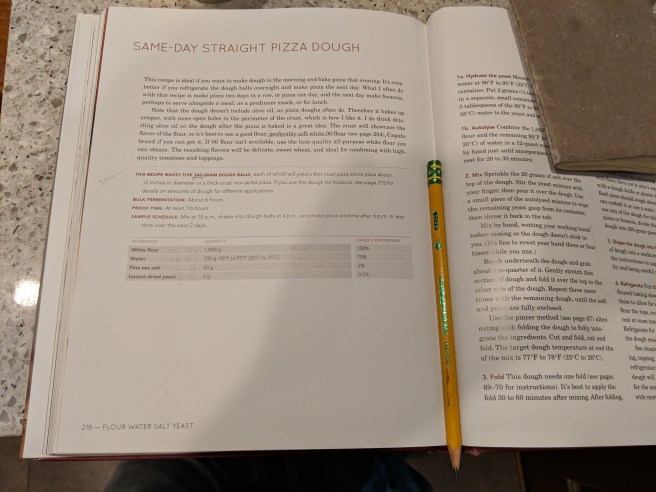
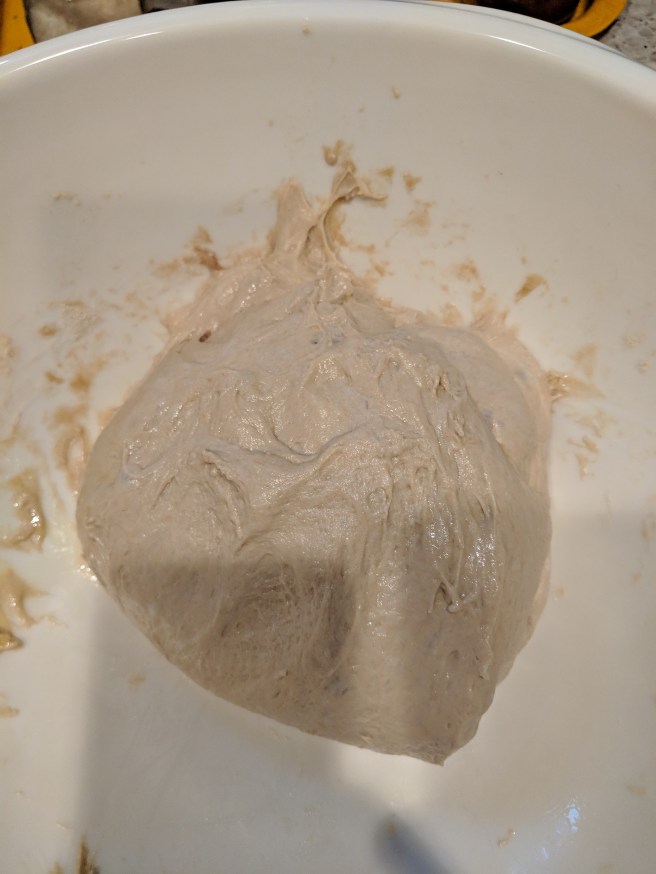
I used a recipe for same-day pizza dough from Ken Forkish’s Flour Water Salt Yeast, but I went a little heavy on the yeast. Fresh milled flour also tends to needs more water. It can really absorb a lot more liquid. This flour just required a little more to get to what I thought would be equivalent for this recipe (recipe of 70% hydration to 75%).


The final pizzas turned out really nice. I even made true caramelized onions for the occasion. For the sheet pan pizza, a trick I came up with last time was to carefully transfer it to a cooling rack and put it back in the oven to fully crisp the bottom. Otherwise the middle stays a bit soft.
The cast iron skillet pizza was designated as the kids pizza, and they stopping running around for about 5 mins to eat. (I will call that a success).
The crust was hearty and wheaty, but not overbearingly so. It had a nice crumb, with a good crisp and chew. I would definitely repeat this pizza dough, but would use an longer ferment time for the dough, rather than a same day dough.


 whole-purpose.com