
A few days ago I ate at what is considered one of best Italian restaurants in Seattle (of a short list). They had cavatelli with duck ragu as a special and, knowing that I had my cavatelli on the home pasta schedule, it was a perfect opportunity to get a comparison. As an aside, it was nice to see a restaurant serving pasta as a proper first (primi) course and not as a main dish. I am not going to go all Big Night on people, but it bothers me that so many otherwise good Italian restaurants serve pasta almost exclusively as a main course.
The restaurant’s cavatelli dish was excellent, however, the actual pasta was not really noteworthy. It carried the sauce, but the flour in the pasta had no distinct flavor. This is not a criticism of the restaurant or chef, it is just the state of flour. Flour is ignored. I suspect great care was taken in sourcing every other ingredient in that dish.
Which brings me to my cavatelli. My gnocchi/cavatelli board arrived in the mail and I wanted to waste no time.
For the milling, I tried a slightly modified semolina milling technique, but the end result turned out less efficient. It was still a three-step grinding and sifting process, but instead of only removing the fine flour before re-grinding, I took out all the fine semolina as well. It just seemed a little more efficient, but it ultimately resulted in less fine semolina as a percentage of starting grain. I also realize that I definitely need new sifters to better sort semolina, particular a lower # mesh. After this cavatelli experiment, it is going to be on the home menu pretty regularly and it will pay off to get this slightly more refined.
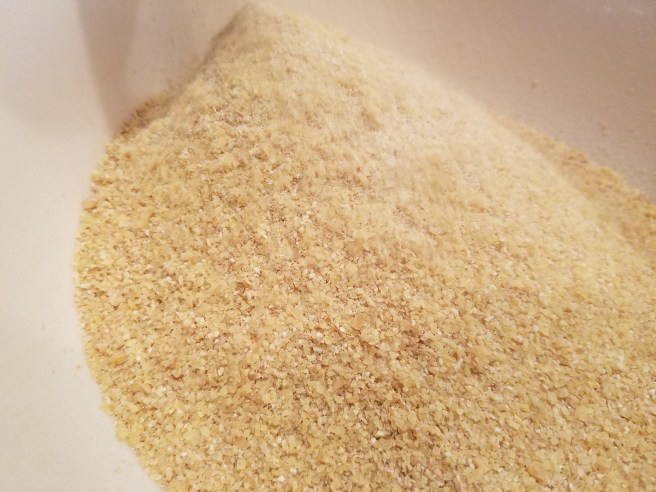
Pictured below is the product of the first rough milling. Final breakdown of 515 grams of durum wheat berries–90 grams durum flour, 130 grams fine semolina, and 285 grams coarse semolina (~10 grams of bran extract).
Cavatelli is a traditional semolina dough and very simple. Dough recipe:
- 250 grams durum (composed of 130g fine semolina, 20g durum flour, 100g coarse semolina).
- 125 grams water
- small pinch of ancient sea salt
- light drizzle of olive oil
The dough was well-kneaded until it formed a smooth and soft pliable ball. The gluten in durum is strong but short and will not be as flexible as regular wheat gluten.

 After resting the dough for an hour or so, I cut it in quarters and rolled out pasta dough snakes. This is probably the most fun you can have making pasta.
I first learned this technique sometime around kindergarten age, when it was still acceptable to make ash trays from clay in art class.

The cavatelli is made by cutting little squares off the dough snake, which are then pressed with your thumb over the gnocchi board with a rolling motion to make little ridged pasta dumplings.

Next time I will make them slightly longer and thinner, but only just a bit. The shape ended up pretty close to how I envisioned.
Final pasta dish: Cabbage braised in a little red wine and garlic, sauteed mushrooms, and speck (smoked prosciutto-like ham).

There was a slight coarseness to the texture and maybe a too al dente cook, but it was very delicious. My daughter isn’t exactly a tough pasta critic, but she was clearly a fan.


 whole-purpose.com