
My first order of Durum wheat berries arrived earlier this week. I am looking forward to comparing them against the Kamut that I have been using for pasta. Until then (hopefully soon), I recently tried a blend of Kamut and Turkey Red to make a variation on a standard egg noodle tagliatelle. This was also a chance to test out my new KitchenAid pasta roller attachment.

First the flour milling (the part this blog is actually about). My Kamut experiments have helped me refine the process of separating the milled Kamut into flour, fine semolina, and coarse semolina. It is a somewhat time-consuming three stage milling and sifting process.
First, I crack the Kamut berries using a wide (coarse) setting on the mill and sift off all resulting flour with an #80 mesh sieve. The coarse ground Kamut goes back through the mill at a medium setting. I repeat the sifting and grinding again at a fine setting. After the third milling, I sift out fine semolina with a #50 mesh sieve from everything that didn’t make it though the #80 mesh. The last step to extract the coarse semolina is a manual process of shaking and carefully scooping off the bigger lighter pieces of bran that float to the top. Then result by percentage is roughly 25% fine flour, 37% fine semolina, and 25% coarse semolina.
As crazy as my wife will think it is, I want to get two new sieves to further refine this process–with a #60 mesh and a #40 mesh, so that my fine semolina is between an #80 and #60 and the coarse semolina is between the #60 and #40 (although maybe #30 would be better).


I also milled some Turkey Red using a very fine mill setting and bolted out the fine flour with my #80 mesh sieve (a 35% extraction).
The noodle dough started as a standard egg noodles recipe, but I decided to add more water and slightly less egg. I wanted to try a mix of a water-based semolina dough and egg flour noodle.
Recipe: 215 grams of 50/50 blend of Kamut fine semolina (and some Kamut flour) / Turkey Red fine flour ; 1 whole egg plus 1 yolk; 1 tbls olive oil; and a fair bit of water until the dough came together.

Fresh flour tends to take more water, so having to keep sprinkling in more was not a total surprise. In the end, there was too much water for that much flour (rather than semolina).
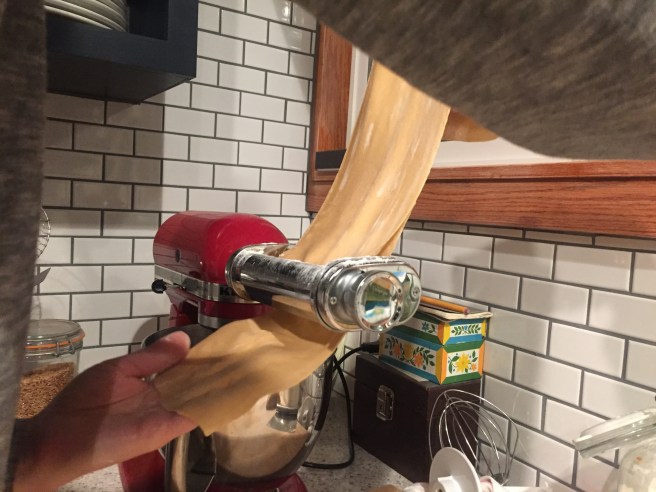 Rolling with the KitchenAid attachment is so much easier than my old counter-(poorly)mounted hand-cranked roller, which I tossed unceremoniously in a fit of meh one day. This is definitely going to help my long flat noodles and stuffed pasta skills. I love to hand roll pasta and won’t give that up, but this is a nice tool to have.
You can see in the picture the dark earthy look of the dough. It amazes me that even this bolted flour (of fairly low extraction ratio), which looks pretty similar to commercial white all-purpose, results in dough with a much darker and richer color (and with a wheaty flavor you just don’t get from non-fresh flour).
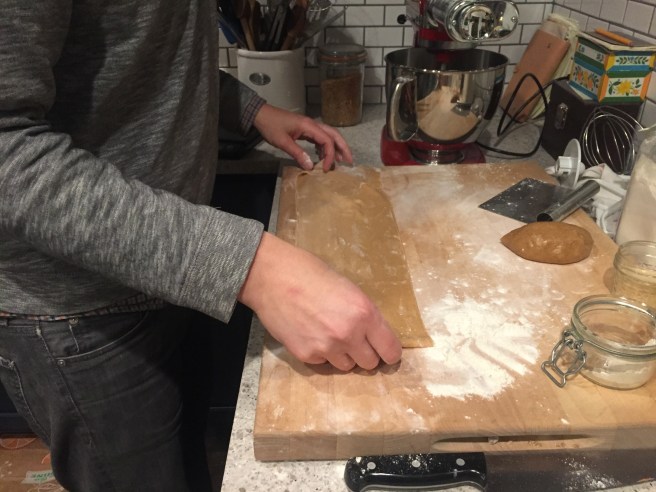
The final product was just so-so, partially because I rolled the dough one level too thin (got carried away be the ease of the new power roller). As a result, the noodles just didn’t have any bite to them. Flavor was not bad, but not a blend of flour or recipe I would use again. As is often the case, the pasta was dressed with a very simple tomato sauce that my wife made. There were plans for a more complex dish, but some version of this sauce is a staple in our house and is the default when time runs short. You can see in the photo that the noodles were too thin and flimsy.
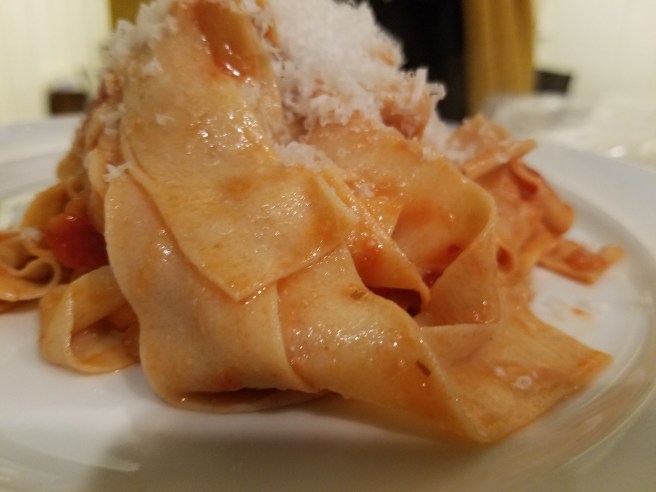

My daughter loved it though. She hasn’t developed an appreciation for al dente yet.
 whole-purpose.com
One thought on “Fresh Milled Kamut/Turkey Red Tagliatelle”