
My wife is from the great plains, not far from the Mississippi. A place I had only driven through a couple times before we started dating, without gaining much of an appreciation for the topography. Even in a car moving at unnatural speeds, the land seems too flat for too long and somewhat unreal. This land, stripped of the native grasses, now produces grain, corn and wheat, and people that reflect quietly.
Turkey Red is one of those grains that tells the story of wheat in the U.S. Introduced by immigrants to the great plains, gaining popularity due to changes in culture and technology (roller mills), and then ultimately being replaced by modern genetic hybrids and the new scientific clone wheat varieties. Whether Turkey Red makes a comeback, like White Sonoran, in the latest chapter of this story is yet to be seen. It may suffer from a name that makes people think of awkward birds, rather than the ancient land now known as Turkey (not a coincidence).The name of the wheat itself is a lesson in etymology and the constant shifting and movement of peoples across lands that change name, to later have no clear connection to the past.
Back to the flour: Test #1 with the Turkey Red was a simple rustic loaf. In typical fashion, I messed up the timing of the rising and proofing, so the final product was not amazing. It was good though. The flour and resulting bread is strong, but I didn’t notice any great distinguishing characteristics on this first go around.
See my earlier video on milling the Turkey Red. Pictured below is the end result after sifting with my fine mesh sifter (#50, not the super fine mesh #120). There is a lot of fairly fine bran. Even after sifting, the flour felt mealy and heavy–not necessarily bad qualities for a good loaf of bread.
 The dough was moderate hydration and left to rise and proof overnight (two nights total):
- Pre-ferment (50g Turkey Red/ 50 grams water, pinch of dry yeast)
- 200 grams Turkey Red sifted flour (total flour 250g)
- 140 grams water (total water 190g) — 76% hydration
- 3 grams dry yeast
- 5 grams salt
Autolyse for 30 mins, mixed in salt (using the pincher method), left to rise overnight with periodic folding (3 times). Removed from fridge the following day and shaped into a round. I then ran out of time to bake and put the shaped dough back in the fridge to proof overnight. Not ideal and probably the primary error.
The dough was easy to work, smooth and developed a good firm tension. Notably, it rose more overnight in the fridge (the first night) than I would have expected. Good enzymes.


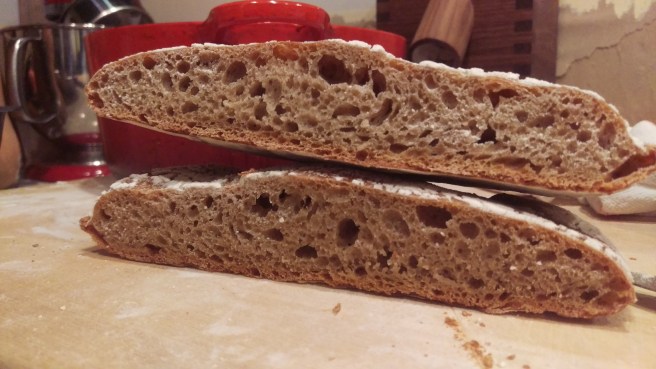
When I did finally get around to baking: 475 degrees for 25 mins covered in a dutch oven, and 20 mins uncovered. The bread didn’t rise much. Overproofed with dying yeast? Underdeveloped gluten structure? Probably a little of both. The crumb was nice though, nice random open pockets with a great chewy texture. At a 78% extraction, the bread was very whole wheaty. This is what inspired me to get the super fine mesh sifter.
(As an aside, I did make one quick biscuit from the first test batch of super fine Turkey Red–it was damn good. My wife said “why did you only make one.” Because . . . umm . . . well, I guess that was kind of dumb.)
The next test is to take the Turkey Red and make dinner rolls. Seems like that is a very great plains classic.

My daughter really seemed to enjoy the bread (with some prune jam to sweeten it up). She knows what she likes now, if she doesn’t it gets tossed off the tray to the dog.
 whole-purpose.com